COACH / TRAINING

PERSONAL BEST
COACHING TIPS TO HELP YOU
RAISE YOUR RUNNING GAME
THE POWER OF 10
The 10-miler might not be as common as other distances, but training for one can improve your running in so many ways
TOP 10
The allure of the 10-miler has endured for hundreds of years
TOP 10
The allure of the 10-miler has endured for hundreds of years
CERTAIN RACES CARRY A ROMANCE and unique attraction for runners. I’m not sure why, tradition perhaps, or the simple appeal of a round number, but the 10-mile distance is one of them. As with the mile, it occupies a special place in the hearts of many runners, despite not being a distance you see run at major championships.
There are reports of 10-mile runs going back to the 18th century, but as a formal event, the distance has been part of the British distance-running scene for over 100 years, and was part of the AAA Championships from before 1900 through to 1972. The oldest 10-mile race in the UK is the famous Brampton to Carlisle race. Organised by Borders Harriers since 1951, the race has seen some famous winners over the years, including Ron Hill, Steve Cram and Aly Dixon.
These days, 10-mile races are significantly less common than 5Ks, 10Ks, half and full marathons, while World Athletics stopped ratifying world records over the distance in 1975, with leading times now recorded as ‘world bests’. Despite this, 10-mile events remain an essential feature of the racing calendar, particularly in countries such as the UK, US, the Netherlands and Belgium. Interest in the distance has surged in recent years, with British and European best times set by Eilish McColgan (50:43 in the Great South Run) and Emile Cairess (45:57 in the Podium Breaking 10).
● Why tackle the 10?
Aside from its history and pedigree, 10 miles is an appealing distance for many runners due to its accessibility. For less experienced runners, the distance is a good progression from 10K. With a half marathon being more than double the distance of the 10K, a 10-miler can provide a sensible next step for those looking to race over longer distances.
For many more experienced runners, the 10-mile distance can be an excellent test of your general aerobic fitness. If the race is going to take between 50 and 70 minutes, there’s likely to be a rough correlation between your race intensity and your maximal lactate steady state. Because of the physiological demands of the distance, always being in shape to run a solid 10-miler is a pretty good state for most competitive runners. It can be an excellent foundation or starting point to aim for a 5K or 10K PB in six to eight weeks – layering on a period of quicker running – but equally, it can demonstrate that you’re in an excellent place to layer on a period of marathon-specific training over the course of eight to 12 weeks.
Of course, sometimes we can also just get stuck in a rut and need a change. Focusing on a 10-mile race can help to break you out of a 10K or half marathon malaise and, as it’s less commonly run, you might be more likely to achieve that confidence-boosting PB.
● Top tips for 10-mile training
Any plan targeting the 10-mile distance will have a lot in common with a typical 10K or half marathon schedule. Despite this, there are some specific areas that can be useful to consider when building your plan:
Sweet spot While I’m not a believer in magic sessions, threshold training is as close to an essential as you can get when training for a 10-mile race. The goal of these sessions, which you run at a 6 to 7/10 effort level, is to lift your effort to the maximum level you can hold while still being able to stabilise it. For more experienced runners, this is likely to be somewhere near 10-mile race effort. Aim to include 15 to 40 minutes of this effort a minimum of every seven to 10 days in your build-up.
Solid or split? When completing your threshold sessions, you can choose to run solid blocks (eg, a 10-to-15-minute warm-up, 20 to 30 minutes of effort and a 10-to-15-minute cool-down), or as split sessions (eg, a 10-to-15-minute warm-up, 4 or 5 x 6 minutes of effort with 1-minute jog recoveries and a 10-to-15-minute cool-down). If you’re less experienced, the split route will allow you to adjust your intensity with each rep to ensure you aren’t working too hard. As you do more threshold work, you should be better able to stop your effort drifting up and thus be able to run longer blocks.
Control intensity To get these sessions right you need to find the right pace – most runners end up running their threshold work too hard. While a rule of thumb is that you should be able to sustain this effort for roughly 60 minutes in a race, many runners will find their effort drifts up through a session. As such, if you start your 15 to 40 minutes of work at your perceived 60-minute effort, you risk working too hard during the second half. If you find your effort drifting in this way, lower your pace – even if it means you’re closer to a half marathon effort. Find that point at which you can stabilise – you want to feel like you’re cruising at speed.
Profile prep If you’re planning on racing a hilly 10-mile race, consider running your threshold sessions over an undulating route. If you ensure you’re running by effort or heart rate, not pace, you can control your intensity but prepare more specifically for the demands of your goal race.
PERFECT 10
Tackling the distance can break you out of a 10K/half marathon rut
PERFECT 10
Tackling the distance can break you out of a 10K/half marathon rut
Work in other distances If you’re looking to set a PB, starting your 10- or 12-week 10-mile prep with a 10K PB could be a great plan. But the same could be said for the role a 10-mile race can play in half marathon training. Aiming for a 10-mile race at your goal half marathon pace eight to 10 weeks before race day would show you’re well on track.
Controlled work If you’ve come into your 10-mile training in great 10K shape, you might be best served by running your faster sessions in a controlled manner. Controlled three-to-five-minute efforts run at 10K effort with a one-minute rest or 60-to-90-second easy run recoveries can be highly effective (eg, 8 x 3 to 4 minutes with 60-second jogs).
Fartlek If you’re less experienced, longer intervals can be hard to manage. Fartlek runs mixing 30-to-60-second efforts around 10K pace with one or two minutes of steady recoveries can often create a similar stimulus.
In touch with speed While I haven’t suggested a lot of higher-intensity speedwork, there are still sessions you can add to your plan to stay in touch with speed. Strides run at 800m pace over 60m to 80m, or short hills run near maximal effort for eight to 10 seconds can be highly effective in the early stages. You could extend these over time to efforts of 100m to 1500m run fast with a 30-second recovery for a greater endurance element.
Going longer The long run remains a critical element of 10-mile training. For less experienced runners, your long run might remain at an easy or steady effort throughout your plan, simply focusing on building more time on your feet as the weeks go by. More experienced runners can explore moving some of their threshold blocks into the later stages of the long run to make a challenging but highly specific session.
Racing shape Adding a 10K race into your training will not only develop your fitness, but also give you the chance to rehearse your race-day routine, including breakfast, kit and warm-up. If you can’t find a race, a parkrun with a good 15-minute warm-up and cool-down would also be effective.
Finish fresh Ten-mile training doesn’t require a huge taper or cutback in training before race day. A week before the race, you might consider trimming your long run back a touch, then ticking over with the same number of runs in race week, but reducing the volume in each.
Pace judgment This is, of course, critical in all long-distance races, but particularly so over the 10-mile distance, where you need to stay just at or below your tipping point of discomfort. Plan to run your first two or three miles no faster than goal race pace, and perhaps aim for five to 10 seconds slower, targeting a negative split (running the second half of the race faster than the first).
CLASSIC UK 10-MILERS
► GREAT SOUTH RUN
Portsmouth, 20 October
The UK’s biggest 10-mile race on the pancake-flat streets where Eilish McColgan set the British women’s record of 50:43 in 2021.
greatrun.org
► CABBAGE PATCH 10
Twickenham, London, October (TBC)
Richard Nerurkar ran 46:06 on this classic flat course, a British record that stood for 30 years; it was broken by Emile Cairess in 2023.
cabbagepatch10.com
► BRAMPTON TO CARLISLE
Cumbria, 17 November
Running for over 70 years, the oldest 10-miler in the UK takes place on a fast point-to-point course.
race-results.co.uk
► FRED HUGHES 10
St Albans, January 2025 (TBC)
Run since 1986 in memory of the former St Albans Striders chairman, this race remains a popular part of the UK club scene.
stalbansstriders.com
► TOM SCOTT MEMORIAL RACES
Motherwell, 7 March
First run in 1962, the event was created as a memorial to local athlete Tom Scott, who was killed in a car accident on his way to a marathon in 1961.
tomscottroadraces.com
Tom Craggs is a coach and road running manager for England Athletics
10-MILE TRAINING PLANS
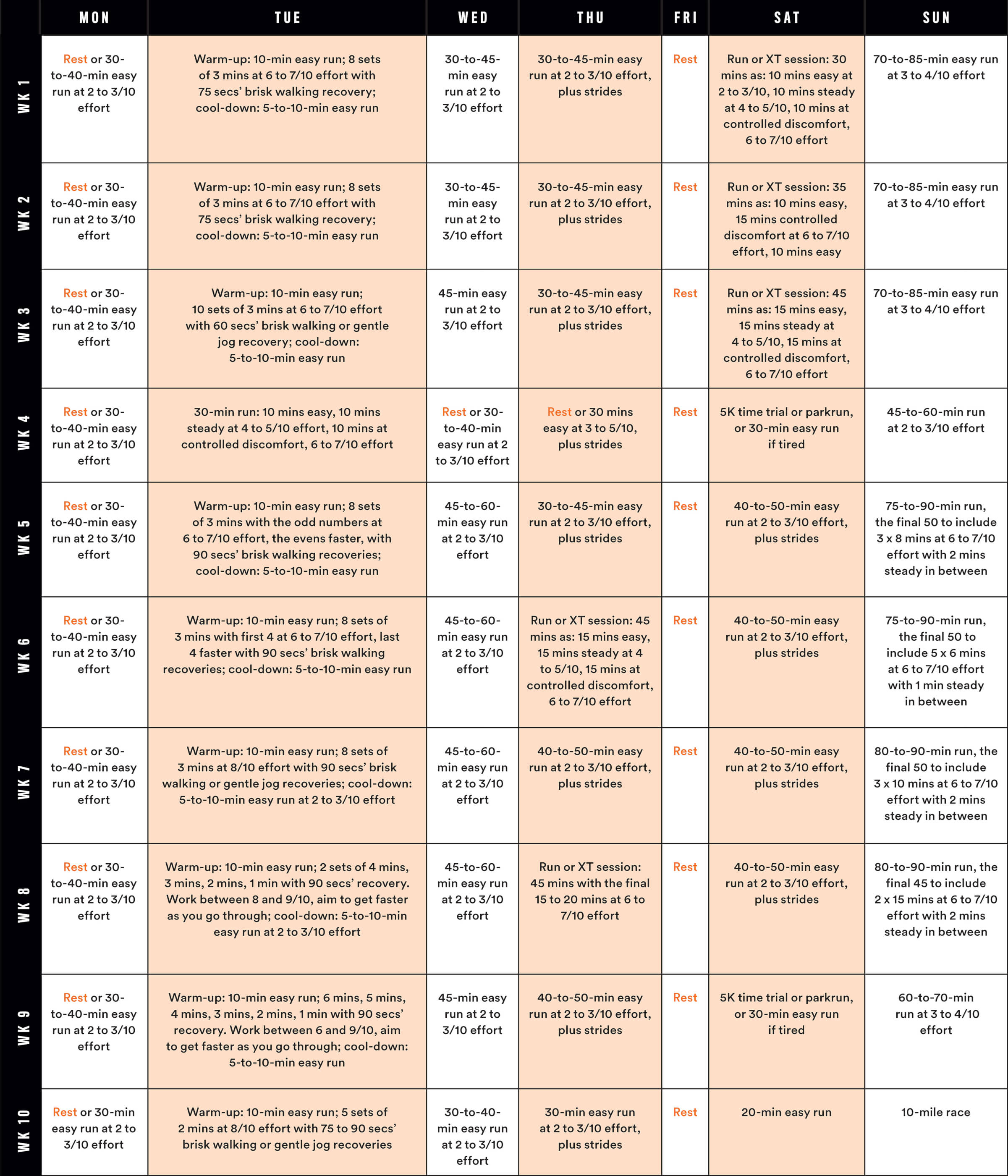
Have a go at tackling your first 10 miles, or improving your PB, with these suggested plans. Adapt the plan to suit your life and experience. If you need to swap days, avoid doing two runs harder than 6/10 effort on back-to-back days. It’s fine to add more running, but remember that you need to recover well to progress. If you’re tired, ill or worried about a niggle, rest and, if necessary, speak to a physio or medical expert. The majority of the sessions are runs, but you can replace some with cross-training (eg, bike, elliptical, aqua jogging, etc) where suggested.
RPE SCALE
WHAT IT MIGHT FEEL LIKE…
0/ A gentle stroll or rest.
1/ Brisk walking or very easy jogging. Able to chat with little to no effort.
2-3/ Easy running. You’re able to hold a conversation. You might find you need to consciously work to slow down, feeling like you could run forever.
4-5/ Steady running. You can speak in short sentences. You might be able to hear yourself breathing, but could keep going for two hours or more at this intensity.
6-7/ Controlled discomfort. A pace you could hold for 60 to 70 minutes in a race. You should be able to speak two or three words at a time. Cruising at speed.
8-9/ Working hard at 3K to 10K effort. You have to focus to maintain pace. You’ll be breathing strongly and will feel like you need the recovery between efforts.
10/ Working very hard. An effort that you can sustain for only short periods of time.
Strides. Short bursts of quicker running over 60m to 80m at a faster pace, but not sprinting. Walk back between each. Complete four to six sets.

SUB-90:00 PLAN
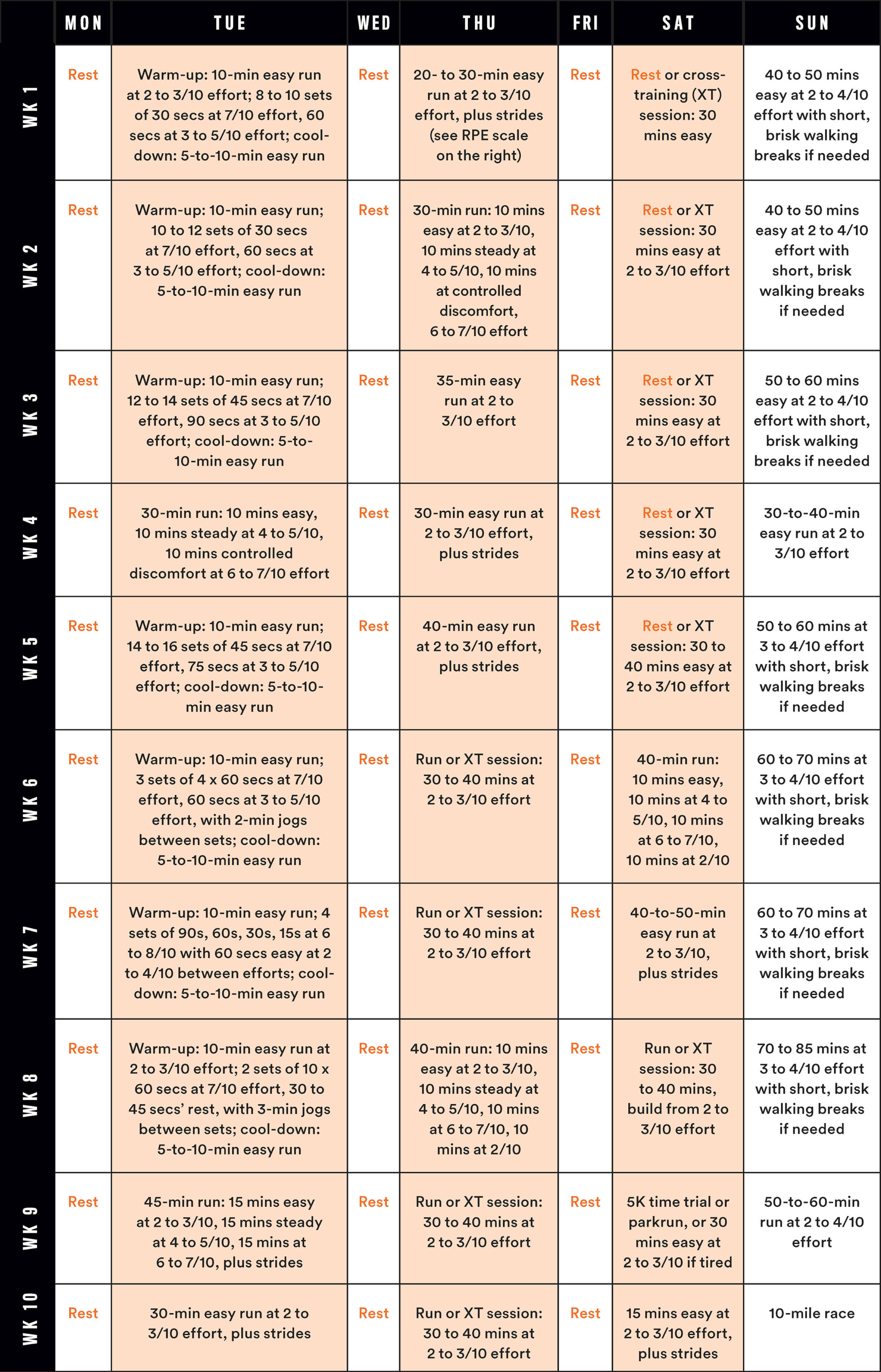
SUB-70:00 PLAN